Annual Report 2025-2026
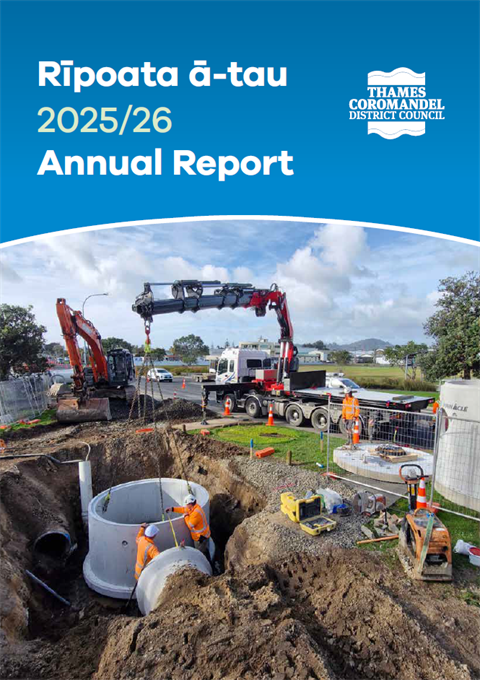
Our Annual Report and Annual Report Summary for the 2025/26 year has now been independently audited, finalised and approved by our Council. The completion of the report completes a year shaped by severe weather, government reform and pressure to balance affordability with investment in essential services. The report reviews how our Council performed compared to what it set out to do, taking note of key highlights and challenges along the way.
Access the full, detailed Annual Report or the Annual Report Summary via links at the bottom of this page.
Key highlights include:
- Road recovery mostly completed, with 180,236m² resurfaced and fewer serious crashes on local roads.
- Communities supported through two States of Emergency, including Cyclone Vaianu, with disaster relief funding provided.
- Climate Change Strategy and Greenhouse Gas Emissions Reduction Plan adopted.
- More than 500 dune-stabilising plants planted at Little Bay.
- Auckland–Coromandel ferry service reinstated and recognised with an award.
- New and replacement public toilets opened across the district.
- Hall upgrades completed in Whitianga, Thames, Coromandel and Whangamatā.
- Hetherington Road stormwater upgrade completed and a new recycling bunker installed in Whangamatā.
- In-house water services unit chosen following public consultation; Citycare Water appointed for operations and maintenance.
- Hāhei Water Treatment Plant opened; Ōamaru Bay wastewater treatment plant consent renewed.
- Building Control retained its nationally leading status.
Read the 2025-26 Annual Report
Read the 2025-26 Annual Report Summary
Messages from our Chief Executive Aileen Lawrie and Mayor Peter Revell
From Chief Executive Aileen Lawrie
Focusing on core services, recovery and smart planning
Our communities have faced a lot this year, and we have been focusing on council’s role in supporting them. In 2025/26, that’s meant concentrating on core services, and smart planning.
Severe weather events in January, March and April reminded us of the importance of resilient infrastructure. The widespread disruption cost around $36.5 million, ($19 million of it from central government). Most of the immediate recovery work has now been done, the rest should be completed next financial year.
On the ground, our teams continue to maintain essential infrastructure and provide regulatory and community services, but there is also a lot of less-visible work on your behalf, including spatial planning and specialist technical work on increasingly complex challenges.
Through it all, we have worked hard to control spending while protecting and maintaining our core infrastructure. Long-term asset management is a perennial challenge, especially when costs are volatile, but we need to ensure our district won’t be overburdened by future infrastructure costs.
I was proud to sign off on some significant infrastructure projects this year, including the completion and opening of the Hāhei and Matarangi water treatment plants. People rely on council to deliver this sort of work, and those communities will benefit for many years to come.
We know there is change on the horizon but that won’t shift our focus from good management and smart planning. It is also important to ensure council staff are prepared for the challenges ahead: You deserve a strong team in your corner.
I would like to thank our staff, contractors and partners for their ongoing commitment to making a positive difference to our communities, and our elected members for the long hours they put in for the good of the district.
Finally, thank you to the people of Thames-Coromandel. By telling us what you need, sharing your insights, and letting us know what is or isn’t working, you play a critical role in local democracy.
Keep talking to us. We will keep listening.
From Mayor Peter Revell
Meeting today’s challenges while planning for tomorrow
The past year has been one of challenge, recovery and some important decisions about the future of Thames-Coromandel.
One of our priorities has been keeping a firm hand on the Council’s finances, in particular, rates. Our Long Term Plan signalled an average rates increase of 7.7% for the 2026/27 year, but cost pressures threatened to push that towards 14%. We made a commitment to bring the increase down, and we delivered. The total rates to be collected across the district in the year ahead increased by just 3.97%.
This year we also restructured how rates are to be allocated, based on the capital value of a property rather than just the land value. As a result, some ratepayers will have increases above the average of 3.97%, others will see little or no increase, and some will see their rates fall.
We finished the year with debt of $99 million, below the $111 million we had forecast. Part of that lower debt reflects capital work that took longer to deliver than planned, and we acknowledge that rather than claim it as a permanent saving. Every dollar the Council spends ultimately comes from our communities, so we have a responsibility to spend and invest carefully.
At the same time, the Government is restructuring water services, reforming resource management and considering significant reform of local government itself. The Council has had to consider what these changes could mean for Thames-Coromandel and how we can best position our district for the future.
I want to acknowledge the work of council staff and leadership, our iwi partners and volunteers and my fellow elected members at the Council and community board tables. Most importantly, thank you to the many people across our district who stepped forward and helped during another demanding year.
Our next Long Term Plan will involve hard choices about affordability and the renewal of ageing infrastructure, but the strength of Thames-Coromandel has always been its people, and we will continue to talk openly with our communities about the choices we collectively face.